Concrete Driveways

We handle concrete installation, repair, replacement, resurfacing, sealing, and staining for homes and commercial properties. Each project is scoped from demolition or excavation through final curing and cleanup.
Explore Service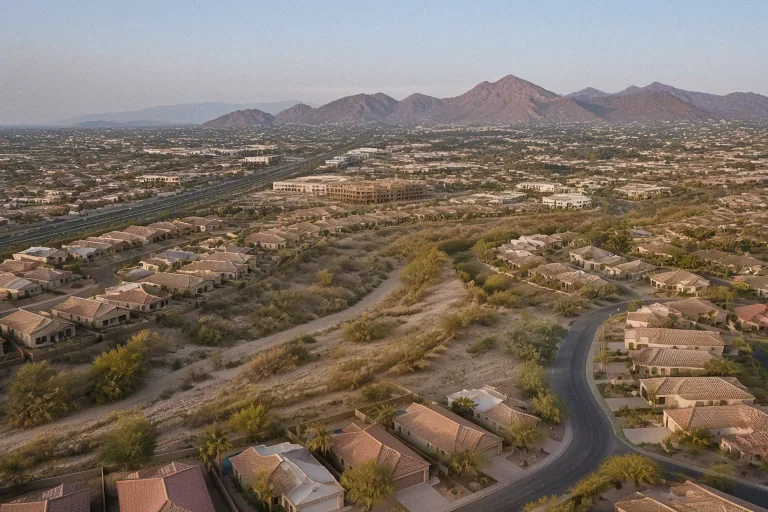
Phoenix Concrete Co. is a licensed, insured, family-owned concrete company serving Glendale, Arizona. We install, replace, repair, and resurface concrete driveways for residential and commercial properties. Our crews also pour walkways, pool decks, foundations, patios, and slabs. Finish options include broom texture, stamped concrete, integral color, exposed aggregate, decorative borders, overlays, sealing, and staining.
Decomposed granite, alluvial soil, and caliche can move beneath slabs as Glendale shifts from triple-digit summers to cool winter nights. We inspect grade and drainage, compact the aggregate base, and select steel reinforcement for the soil and expected traffic load. Summer pours are scheduled and cured with extreme surface heat in mind. Required City of Glendale permits and applicable dust-control steps are addressed before soil is disturbed.
Request a free same-day concrete estimate, and we will walk the property before quoting the project.
Our Glendale work spans downtown, Catlin Court, Berkeley Park, Sahuaro Ranch, Arrowhead Ranch, Stetson Hills, Sahuaro Ranch Estates, Arrowhead Towne Center, State Farm Stadium, and newer development near Loop 303. Crews also serve Peoria, Surprise, Phoenix, Litchfield Park, and Buckeye throughout the West Valley. For another nearby service area, see Peoria, AZ .
We handle concrete installation, repair, replacement, resurfacing, sealing, and staining for homes and commercial properties. Each project is scoped from demolition or excavation through final curing and cleanup.
Explore Service
New driveways begin with excavation, a compacted aggregate base, and either #3 or #4 rebar or wire mesh based on soil and traffic. Standard driveways use a 4-inch slab, while truck and RV areas may require 5 to 6 inches.
Explore Service
Stable cracks may be treated with polyurethane or epoxy injection, while heaved sections can require full-depth patching with a bonding agent. Minor repairs can often be completed in a single day after the failure and surrounding base are evaluated.
Explore Service
Sealing every 2 to 3 years helps limit moisture intrusion and UV degradation. We also evaluate worn surfaces for resurfacing, overlays, or staining when the underlying slab remains suitable.

Replacement includes saw-cutting and removal, debris haul-off, sub-base correction, grading review, and a new pour. Typical replacement projects run $3,200 to $11,500 depending on square footage, access, base conditions, and finish.

A free on-site estimate includes measurements, existing-grade review, drainage checks, and a look at soil and slab conditions. That inspection determines whether repair, resurfacing, or full replacement is the sounder path.

Glendale's roughly 248,325 residents live among 1960s ranch homes, 1990s subdivisions, and new construction near Loop 101 and Loop 303. We adapt driveway, patio, pool-deck, and walkway plans to the grade, existing hardscape, finish preferences, and HOA requirements described for each property.

Commercial work includes parking areas, pads, foundations, slabs, and reinforced access surfaces. Thickness, reinforcement, grade, and finish are selected around traffic load, site access, and project use.

When sudden cracking, heaving, or spalling creates a safety or access concern, request an on-site evaluation. We identify whether stable-crack treatment, full-depth patching, or replacement is appropriate without promising an unsupported repair method before inspection.

Every estimate is free, and same-day concrete estimates are available. We walk the property, measure the work, review base prep and access, and provide plain and upgraded finish pricing side by side.
The right concrete plan balances the site's base, traffic load, drainage, finish, curing conditions, and budget. An on-site review helps separate a repairable surface issue from movement or sub-base failure that calls for replacement.
Ask how the aggregate base will be compacted and whether #3 rebar, #4 rebar, or wire mesh suits the soil and traffic. Reinforcement cannot compensate for an unstable or poorly graded sub-base.
A standard driveway is generally poured 4 inches thick, while surfaces for trucks or RVs may be 5 to 6 inches. Vehicle use should be decided before excavation and reinforcement are finalized.
Integral color adds roughly $1 to $3 per square foot, stamped finishes add $2 to $6, and exposed aggregate generally runs $10 to $16 per square foot depending on stone selection. Compare these with a plain broom-finish price before choosing decorative borders, patterns, or texture.
A replacement should correct the drainage or grading issue that contributed to the old slab's failure. Low-lying areas near the Grand Canal or Skunk Creek can require a different runoff plan than higher ground near Thunderbird Road.
Glendale receives roughly 300 days of sunshine annually, and driveway surface temperatures can exceed 140 degrees Fahrenheit. Early-morning placement, controlled set time, and curing under wet burlap or curing compound help limit flash-set, crazing, and dusting.
Compare estimates by demolition, haul-off, excavation depth, base correction, reinforcement, slab thickness, finish, and site access. Permit fees vary by scope, so they should not be hidden inside an unexplained per-square-foot number.
Summer highs well over 100 degrees, winter nights in the 40s, caliche, and monsoon moisture all place stress on Glendale flatwork. The visible symptom may be a crack or worn surface, but the cause can sit in the base, grade, joint layout, or curing history.
Request InspectionExpanding and contracting decomposed granite, alluvial soil, and caliche can open cracks when the base or reinforcement does not manage movement. Small openings can widen as heat cycles and water intrusion weaken support below the slab.
A slab that has dropped, lifted, or shifted may have a compromised sub-base or trapped moisture below it. Inspection determines whether a localized full-depth patch is practical or whether replacement will better address the cause.
Improper curing in extreme heat can leave concrete dusty, crazed, or flaking within the first year or two. Resurfacing may suit a stable slab, while deep deterioration or movement can make replacement the better long-term option.
Caliche drains poorly and can trap water beneath flatwork when monsoon rain arrives from July through September. Correct base depth, compaction, and surface grading help keep runoff from undermining the slab.
Rapid hydration in intense summer heat can cause flash-set or surface crazing, while long-term UV exposure wears unprotected finishes. Pour timing, controlled curing, and periodic sealing all matter in this climate.
Control joints are generally spaced every 8 to 10 feet in standard driveway slabs to guide expected cracking. Poor placement can concentrate seasonal expansion and contraction across the visible surface instead.
Phoenix Concrete Co. combines local soil and climate experience with direct, family-owned project oversight. From the free estimate through the final walkthrough, you work with the crew responsible for preparing, pouring, and finishing the slab.
Our crews carry Arizona Registrar of Contractors licensing and full liability insurance. We also obtain required City of Glendale permits and address Maricopa County Air Quality Department dust-control requirements for excavation and grading.
Conditions vary from older neighborhoods to commercial pads near Westgate Entertainment District. Site-specific base prep, reinforcement, grading, and curing can separate a driveway that lasts 25 to 30 years from one that needs replacement in ten.
Your call is not routed through a national dispatch center. The local crew stays involved from property measurements and finish selection through cleanup, the finished-driveway walkthrough, and final payment.
Each project moves from an on-site assessment to permits, base work, reinforcement, placement, curing, and a final walkthrough. The sequence protects finish quality while accounting for drainage, heat, access, and the intended vehicle load.
We measure square footage, review access and existing grade, check drainage toward the street or side yard, and inspect the slab and soil. The estimate is free and based on what we see at the property.
We plan slab thickness, reinforcement, grade, finish, and runoff, then pull required permits through the City of Glendale Building Safety Division. Permit review typically takes a few business days depending on project scope.
Existing concrete is saw-cut, removed, and hauled away when replacement is needed. We excavate, correct drainage or grading concerns, and compact the aggregate base for the site conditions.
Forms establish the correct elevation and runoff path before rebar or wire mesh is placed. Control joints and reinforcement are laid out for the slab dimensions, soil, and expected traffic.
Concrete is placed and finished with the selected broom, stamped, exposed-aggregate, colored, or decorative treatment. Summer pours begin early to control set time and finish quality in Glendale heat.
The slab cures under wet burlap or curing compound for several days before foot traffic. Wait 7 days before driving on new concrete and a full 28 days before parking heavy vehicles; after cleanup, we walk the finished work with you before final payment.
Case Study 1: Older ranch homes: Replacement planning can address settled slabs, outdated reinforcement, poor drainage, and a simple broom finish that fits an established streetscape.
Case Study 2: Subdivision and custom homes: Integral color, stamped patterns, exposed aggregate, and decorative borders can coordinate with stucco, roof tile, desert landscaping, and HOA finish requirements.
Case Study 3: Commercial pads and RV access: Heavier-use areas can be scoped with greater slab thickness, load-appropriate reinforcement, access planning, and grading for runoff.
Request a free on-site estimate for driveway installation, repair, resurfacing, replacement, or related flatwork in Glendale. We will measure the site, review soil and drainage conditions, explain finish choices, and quote the scope before work begins.
These answers cover pricing, slab design, finishes, permits, curing, maintenance, and local service areas. A property visit is still needed to confirm square footage, base conditions, drainage, access, and the right repair or replacement scope.
Call Our Concrete TeamA 100-foot driveway at a typical 12- to 16-foot width covers about 1,200 to 1,600 square feet. At $8 to $12 per square foot for standard broom-finish concrete, the basic total is about $9,600 to $19,200 before decorative upgrades. Stamped, colored, or exposed-aggregate finishes can add $2 to $10 per square foot. Excavation depth, slab removal, drainage grading, and site access can change the final quote.
A plain gray slab with a standard broom finish is generally the most affordable choice at $8 to $12 per square foot installed. Avoiding stamping, integral color, and exposed aggregate provides the largest finish-related savings. A 4-inch slab is standard for typical driveway use, while heavier loads may require additional thickness.
Arrowhead Ranch is described as one of Glendale's most desirable neighborhoods, with golf-course frontage, mature landscaping, and newer custom homes near Loop 101. Sahuaro Ranch and newer areas near Arrowhead Towne Center are also well regarded. Driveway finish and color requirements can vary by HOA, so those requirements should be checked during design.
Concrete flatwork over $1,000 in labor and materials generally requires an Arizona Registrar of Contractors license. An owner-builder permit may be possible for some smaller DIY slabs, but professional driveways, foundations, and structural flatwork should meet City of Glendale code. Phoenix Concrete Co. carries Arizona Registrar of Contractors licensing and full liability insurance.
Standard broom-finish concrete runs about $8 to $12 per square foot installed. Decorative stamped or exposed-aggregate work can reach $10 to $20 per square foot or more depending on complexity. Commercial slabs and foundations are priced around thickness, reinforcement, access, and scope, while permit fees vary by project.
Glendale's noise ordinance generally limits loud construction during early-morning and late-night hours. Summer pours are often scheduled before 6 a.m. to control heat, with delivery timing coordinated around acceptable work hours and neighborhood disruption. The actual schedule should be confirmed for the property and project.
A standard driveway is generally 4 inches thick. Areas expected to carry trucks or RVs may be 5 to 6 inches, with reinforcement selected for the soil and load. Thickness, base depth, and steel layout should be decided together rather than as separate upgrades.
Wait 7 days before driving on a new slab. Heavy vehicles should stay off for a full 28 days. The surface cures under wet burlap or curing compound for several days before even foot traffic is appropriate.
Concrete sealing every 2 to 3 years helps reduce moisture intrusion and UV degradation. The appropriate timing depends on surface wear, finish, exposure, and whether water is entering cracks or joints.
Caliche, alluvial soil, and decomposed granite can shift as moisture and temperature change. Triple-digit heat accelerates hydration during a pour, while seasonal movement later stresses the slab. Proper base preparation, reinforcement, curing, drainage, and control-joint placement all reduce avoidable cracking.
Stable cracks may be candidates for polyurethane or epoxy injection, and some damaged areas can be full-depth patched with a bonding agent. Widespread settlement, spalling, heaving, or sub-base failure may make full replacement more cost-effective over time. An on-site inspection is needed to identify the cause.
Options include stamped flagstone, brick, or cobblestone patterns; integral or dry-shake color; exposed aggregate; decorative borders; saw-cut banding; overlays; staining; and sealing. Integral color runs through the slab thickness, while exposed aggregate creates a textured, non-slip surface. Finish selection can coordinate with stucco, roof tile, and desert landscaping.
Service covers downtown Glendale, Catlin Court, Berkeley Park, Sahuaro Ranch, Arrowhead Ranch, Stetson Hills, Sahuaro Ranch Estates, and areas near Arrowhead Towne Center, State Farm Stadium, and Loop 303. Crews also work in Peoria, Surprise, Litchfield Park, Buckeye, and the broader West Valley areas named in the project scope.
Phoenix Concrete Co. pulls required permits through the City of Glendale Building Safety Division before breaking ground. The company is also familiar with Maricopa County Air Quality Department dust-control requirements that apply to excavation and grading. Permit timing and fees depend on project scope.
The process begins with measurements, grade and drainage review, an estimate, and permit planning. Existing concrete is removed when needed, then the site is excavated, compacted, formed, reinforced, poured, and finished. Curing, cleanup, and a final walkthrough complete the project before final payment.